
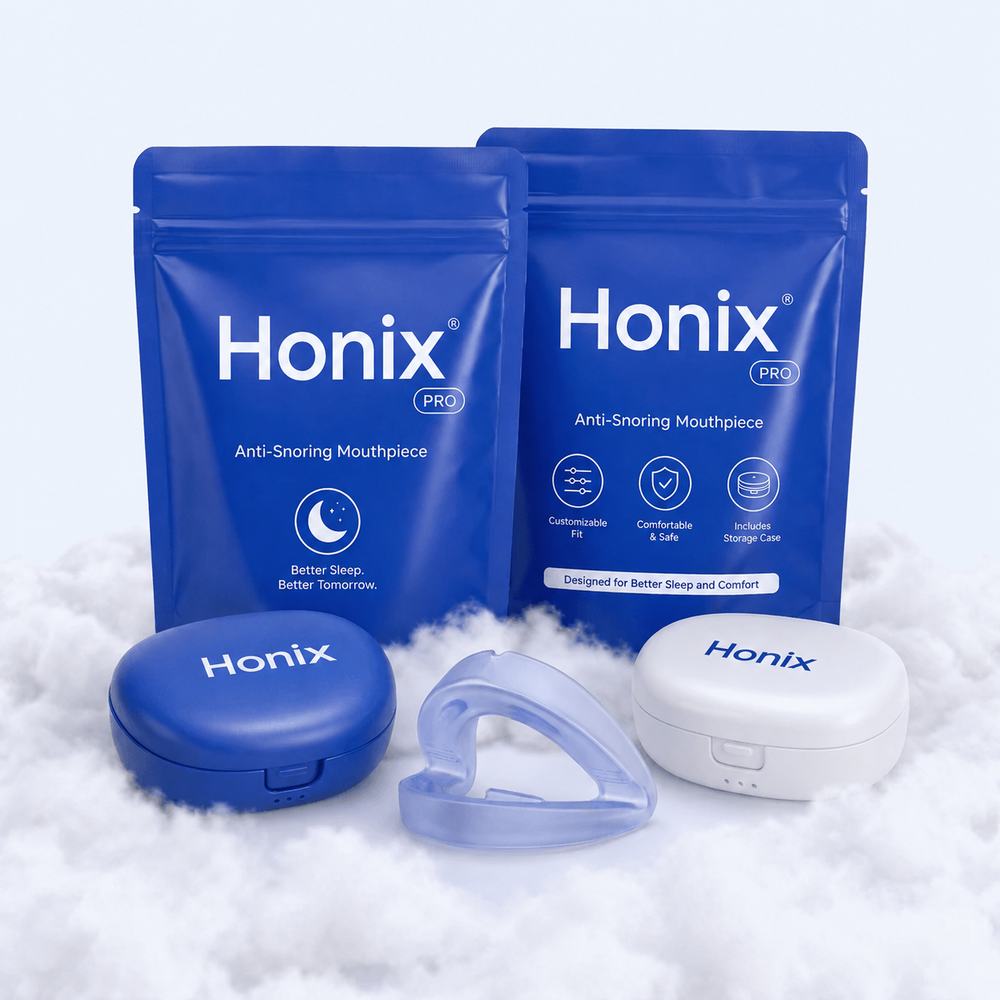
Honix® Adjustable AntiSnoring Mouthpiece
Quiet nights for both of you.
- Share a bed again, without the elbows or earplugs
- Slim, flexible fit you can wear straight out of the box
- Breathe, sip water and talk while it’s in
- Try it for 60 nights. Love the quiet or send it back
Be honest. How many of these happened this month?
Tick every one that’s true for you, then see what it says about you.
Tick at least one first.
Your result · 0 of 0 ticked
Your snoring gets worst on your back.
On your back, gravity pulls your jaw and tongue toward your throat and narrows your airway. That’s why rolling over helps for a while, and why it always comes back. The fix isn’t changing how you sleep. It’s keeping your jaw from sliding back.
Your snoring is wrecking your own sleep too.
When your airway narrows, your body works harder to breathe all night, and your sleep gets lighter and more broken, even if you never fully wake up. That’s the eight-hours-and-still-exhausted feeling.
Everyone hears it but you.
You’re asleep when you snore, so you’re the last to know how loud it gets. For the person next to you, it’s a wake-up call every night, and that adds up.
You’ve been fixing the wrong spot.
Strips and sprays work on your nose. Extra pillows and side-sleeping change your position. But snoring usually starts further back: your jaw relaxes, your tongue slides back with it, and your airway narrows. Nothing you’ve tried has touched that.
With 0 of 0 ticked, this isn’t an off night. It’s most nights.
You’re not a light sleeper. You’re being woken up.
Every snore can pull you out of deep sleep, and once your brain is listening for the next one, it’s hard to drop back in. That’s why a few bad nights a week can feel like you never sleep at all.
You’ve been managing the noise instead of fixing it.
Earplugs, white noise, racing to fall asleep first. They all treat the sound. The sound comes from their airway narrowing when their jaw drops back at night, and none of those touch that.
Snoring is starting to come between you.
Separate rooms, couch nights, short tempers in the morning. A lot of couples end up there without ever deciding to. It isn’t about how you feel about each other. It’s about an airway, and that part is fixable.
0 of 0 isn’t a rough patch. It’s most nights.
One thing you ticked can be a sign of sleep apnea, where breathing actually stops during sleep. Please mention it to a doctor. It needs more than a fix for the noise.
Also in your answers
Your sleeping position makes it worse: on your back, your jaw slides back and narrows your airway even more.
It’s breaking up your own sleep too, not just your partner’s.
And it’s loud enough that the people around you are paying for it.
Everything you’ve tried so far aimed at your nose or your position, not your jaw, where it starts.
You’re losing deep sleep too, even on nights you don’t remember waking.
The workarounds you’re using only treat the noise, not where it comes from.
It’s starting to put distance between you at night, too.
What’s behind what you ticked
None of this means something is wrong with your relationship. It means an airway is narrowing at night, and that part is fixable.
This isn’t a medical test. If you or your partner stop breathing, gasp or choke during sleep, or feel exhausted every day, talk to a doctor.
If this is your house, you’re far from alone.
- 31%
- of U.S. adults have tried a “sleep divorce”, sleeping in separate beds or rooms.
- American Academy of Sleep Medicine, 2025
- 1 hr
- of sleep lost per night, on average, by bed partners of heavy snorers.
- Mayo Clinic Sleep Disorders Center
- 21×
- an hour, on average, that partners of snorers were at least partly woken.
- Mayo Clinic study, via Tampa Bay Times
Figures describe snoring in general, not Honix customers.
What you’ve tried
You’ve tried the easy fixes. Here’s why they let you down.
-
Nasal strips
Wrong spotThey pull your nostrils open, which can help when a stuffy nose is the cause. But persistent snoring usually starts further back, in the throat, and studies haven’t consistently shown strips stop it.
-
Mouth tape
RiskyA 2025 review of the research found little evidence it helps, and flagged real risk for anyone whose nose blocks up overnight. Your mouth is your backup airway.
-
CPAP machines
Hard to live withEssential for diagnosed sleep apnea, and if you’ve been prescribed one, keep using it. But in studies only about half of people manage to keep the mask on night after night.
-
Drugstore mouthguards
BulkyBoil, bite, hope. Thick plastic that can set off gagging and drooling, or end up on the pillow at 3 a.m. Plenty were designed for teeth grinding, not for holding an airway open.
-
Custom dentist devices
Slow and priceyThey work, and they’re the gold standard. They can also mean impressions, follow-up appointments, weeks of waiting and a bill in the hundreds to thousands.
-
Sleeping apart
Costs you closenessIt stops the noise, and it takes away falling asleep together. One study of women living with heavy snorers found that moving to another room didn’t make their sleep complaints go away.
Each of these either aims at the wrong spot or asks you to give something up. The real cause sits further back, behind your tongue.
Snoring isn’t a nose problem. It starts with your jaw.
Here’s what happens a few minutes after you fall asleep.
-
Your muscles relax.
Including the ones that keep your lower jaw in place.
-
Your jaw slides back, and your tongue goes with it.
The base of the tongue drifts toward the back of your throat.
-
The airway narrows and starts to flutter.
Air squeezes through a smaller gap and the soft tissue vibrates. That vibration is the sound everyone else hears.
-
Support the jaw, and the airway stays open.
Honix gently holds your lower jaw slightly forward, so your tongue stays forward too and air moves through quietly.
Jaw drifts back. Airway narrows. Tissue vibrates. Jaw supported. Airway open. Quiet.
It’s not a hack. It’s the method sleep doctors already use.
Honix is a mandibular advancement device: a mouthpiece that holds the lower jaw slightly forward so the airway stays open. Dentists and sleep specialists have relied on this approach for decades. Honix brings it home without impressions, appointments or a dentist’s bill.
91% vs 58%
First-line
10 years
Studies looked at mandibular advancement devices as a category, not Honix specifically. Results vary from person to person.

It was never really about the noise.
It’s about the conversation that trails off in the dark. Reaching over at 3 a.m. and finding someone there. Waking up next to each other instead of down the hall.
Honix is a small, quiet piece of flexible plastic. What it gives back is a lot bigger.
-
Your bed back
Fall asleep together, the way you used to.
-
Your mornings back
No dry mouth, no foggy head, no look across the breakfast table.
-
Your trips back
Book the double room. Take the red-eye. Share the cabin.
-
Your patience back
Two people who slept are kinder to each other. It really is that simple.
Your first month
What the first 30 nights look like
-
Night 1
It feels new.
A little extra saliva is normal while your mouth gets used to it. Often the person next to you notices the quiet before you do.
-
Nights 2–7
Your jaw settles in.
Any morning tightness usually fades within the first week as your muscles adapt.
-
Week 2
The guest room is a guest room again.
Same bed, same time. No pillow wall, no 1 a.m. elbow.
-
Week 3
Travel stops being stressful.
Shared hotel rooms, overnight flights, the cabin with friends. You stop bracing for it.
-
Day 30
Mornings feel different.
Fewer wake-ups for both of you means more patience, more energy and fewer arguments about who kept whom up.
That’s 30 nights. Your 60-night guarantee still has 30 to go.
Everyone adapts at their own pace.
How Honix stacks up
| Feature | Honix | Custom dentist device | Drugstore boil-and-bite | Nasal strips |
|---|---|---|---|---|
| Holds the jaw forward to open the throat | Yes | Yes | Partly | No |
| Ready to wear: no boiling, no impressions | Yes | No | No | Yes |
| Slim enough to sleep in comfortably | Yes | Yes | Partly | Yes |
| No appointments or waiting | Yes | No | Yes | Yes |
| Reusable night after night | Yes | Yes | Yes | No |
| Typical cost | Low, one-time | Hundreds to thousands | Low | Ongoing refills |
| 60-night guarantee | Yes | Varies | Varies | Varies |
Based on typical products in each category.
Couples who got their nights back
Ten out of ten
It’s been a real game changer. It works so well, it’s so easy to use, so comfortable, and apparently I don’t snore anymore.
Wish I bought this sooner
Honestly didn’t expect much but wow. My wife says I barely snore now and we’re finally getting a good night's sleep. Definitely worth it!
Actually comfortable!!
I've tried other mouthpieces and they were so uncomfortable. This one is much easier to sleep with and my snoring has gotten so much better. Really happy with it so far!
Two ways tonight can go.
Another night like last night
- Earplugs in.
- An elbow at 1 a.m.
- Someone takes a pillow to the couch.
- Another recording you didn’t ask for.
The night you’ve been missing
- Lights out, same bed.
- A conversation that trails off.
- Quiet.
- Waking up next to each other.
60-night guaranteeFree shipping
Sleep on it. For 60 nights.
Use Honix for up to 60 nights. If you’re not sleeping better, or the person next to you isn’t, send it back under our return policy for a refund.
The only thing you’re risking is another night like last night.
Questions people ask before their first night
Will it hurt my jaw?
No, Honix is designed with a slim, comfortable fit that feels less bulky than traditional mouthpieces. It's made for comfortable overnight wear without unnecessary bulk. If you experience jaw or tooth pain, stop using it and consult your dentist.
Will I drool?
A little extra saliva is common for the first few nights, because your mouth treats anything new like food. It settles down quickly for most people.
Can I breathe through my mouth, drink water or talk with it in?
Yes. Honix is slim and flexible, so you can open your mouth, sip water and say goodnight without taking it out.
Do I need to boil or mold it?
No. Honix is ready to wear out of the box: no boiling water, no impressions, no appointments.
How fast will we notice a difference?
Many couples notice a quieter night from the first use. Give your jaw a full week to get used to it before you judge comfort.
Who shouldn’t use Honix?
Talk to your dentist first if you wear dentures, have loose teeth, braces or active gum disease, or have TMJ problems or ongoing jaw pain.
I’m buying it for my partner. Any tips?
Make it about your sleep, not their flaws. “I miss sleeping next to you” lands far better than “you’re so loud.” The 60-night guarantee helps too: it’s an easy thing to say yes to.
How do I clean it?
Rinse it every morning, brush it gently with a soft toothbrush and mild soap, let it dry fully and keep it in its case.
What if it doesn’t work for us?
You’re covered by our 60-night quiet guarantee. Send it back within 60 days under our return policy for a refund.
